Removing the ones that do not map equally
So as a test case, let’s get an even more extreme case, ALE-HEI-f28a35b5-17 which has 8 hits listed,
but in reality only x0107 and x1093 are required. The rest is just noise.
Given three hits, the atoms maps can be A -> B -> C = A -> C …or not.
What happens when the most fragments that are most disruptive are removed?
from fragmenstein import Fragmenstein
import itertools
from collections import Counter
from rdkit import Chem

class Þragmenstein(Fragmenstein): # mocked class.
    def __init__(self, hits):
        self.hits = hits
        self._debug_draw = False


mpro_folder = '/Users/matteo/Coding/Mpro'

def get_mol(xnumber):
    xnumber = xnumber.strip()
    mol = Chem.MolFromMolFile(f'{mpro_folder}/Mpro-{xnumber}_0/Mpro-{xnumber}_0.mol')
    mol.SetProp('_Name', xnumber)
    return mol

# using the inspiration hits from ALE-HEI-f28a35b5-17
hit_codes = ['x0107', 'x0395', 'x0434', 'x0678', 'x0967', 'x0991', 'x1093']
hits = [get_mol(h) for h in hit_codes]
þ = Þragmenstein(hits)

## Dodginess removal approach

def get_dodgies(skippers):
    dodgy = []
    for hit0, hit1, hit2 in itertools.combinations(þ.hits, 3):
        hn0 = hit0.GetProp('_Name')
        hn1 = hit1.GetProp('_Name')
        hn2 = hit2.GetProp('_Name')
        if any([hit in skippers for hit in (hn0, hn1, hn2)]):
            continue
        for a, b in m[(hn0, hn1)].items():
            if a in m[(hn0, hn2)] and b in m[(hn1, hn2)]:
                if m[(hn0, hn2)][a] != m[(hn1, hn2)][b]:
                    dodgy.extend((hn0, hn1, hn2))
                    #print(f'{hn0}.{a} - {hn1}.{b} : {hn2}.{m[(hn0, hn2)][a]} - {hn2}.{m[(hn1, hn2)][b]}')
    d = Counter(dodgy).most_common()
    if dodgy:
        return get_dodgies(skippers=skippers+[d[0][0]])
    else:
        return skippers

for distance in (0.6, 1, 2, 5, 10):
    m = {}
    for h1, h2 in itertools.combinations(þ.hits, 2):
        m[(h1.GetProp('_Name'), h2.GetProp('_Name'))] = þ.get_positional_mapping(h1, h2, distance)

    print(distance, get_dodgies([]))
Gives
Å Troublemakers
0.6 ['x0434']
1 ['x0434', 'x0967']
2 ['x1093', 'x0395', 'x0107', 'x0434']
5 ['x1093', 'x0395', 'x0967', 'x0107']
10 ['x0395', 'x1093', 'x0967', 'x0434']
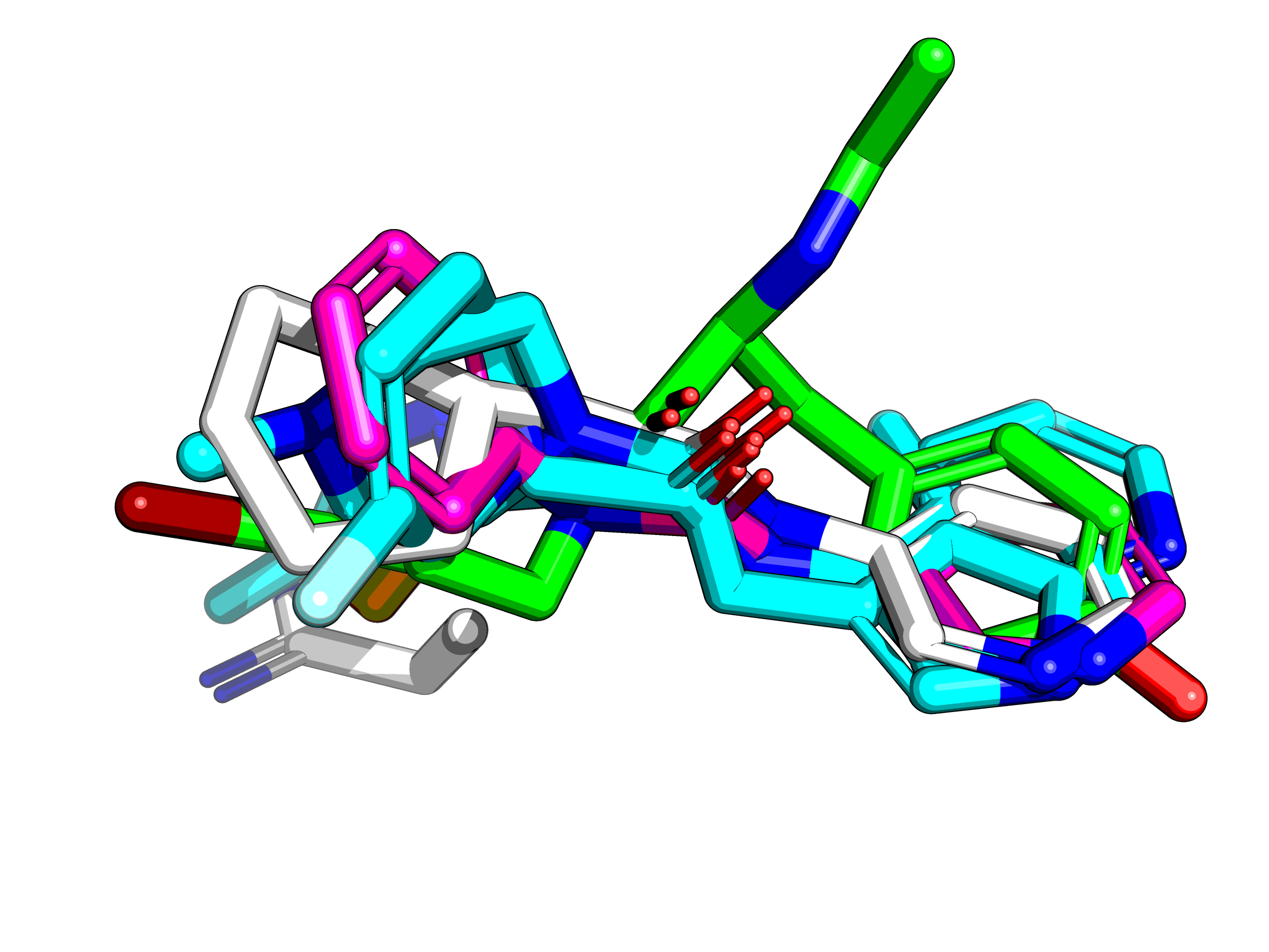
x1093 and x0107 are removed at 2 Å due to the ring. Consequently, the code implemented to get rid of dodgy mappings does not include rings. However, for a more realiable, solution, the rings need to be collapsed.