Predicting new followups
Fragmenstein can also merge fragments and suggest its own (cf. Moonshot result).
The method Victor.combine does this.
Merging
The merging uses a 2 Å positional overlap mapping with the rings collapsed and subsequently expanded and re-bonded by proximity with several corrections done for corner cases.
Ring collapse
This is a seemingly “simple” solution to avoid weird bonding issues —overlaps of 5-rings with 6-rings, perpendicular rings, etc.
What happens is that all rings are replaced with a single atom that can be unpacked later.
Ring class in core._collapse_ring does exactly that (inherited by Frankenstein).
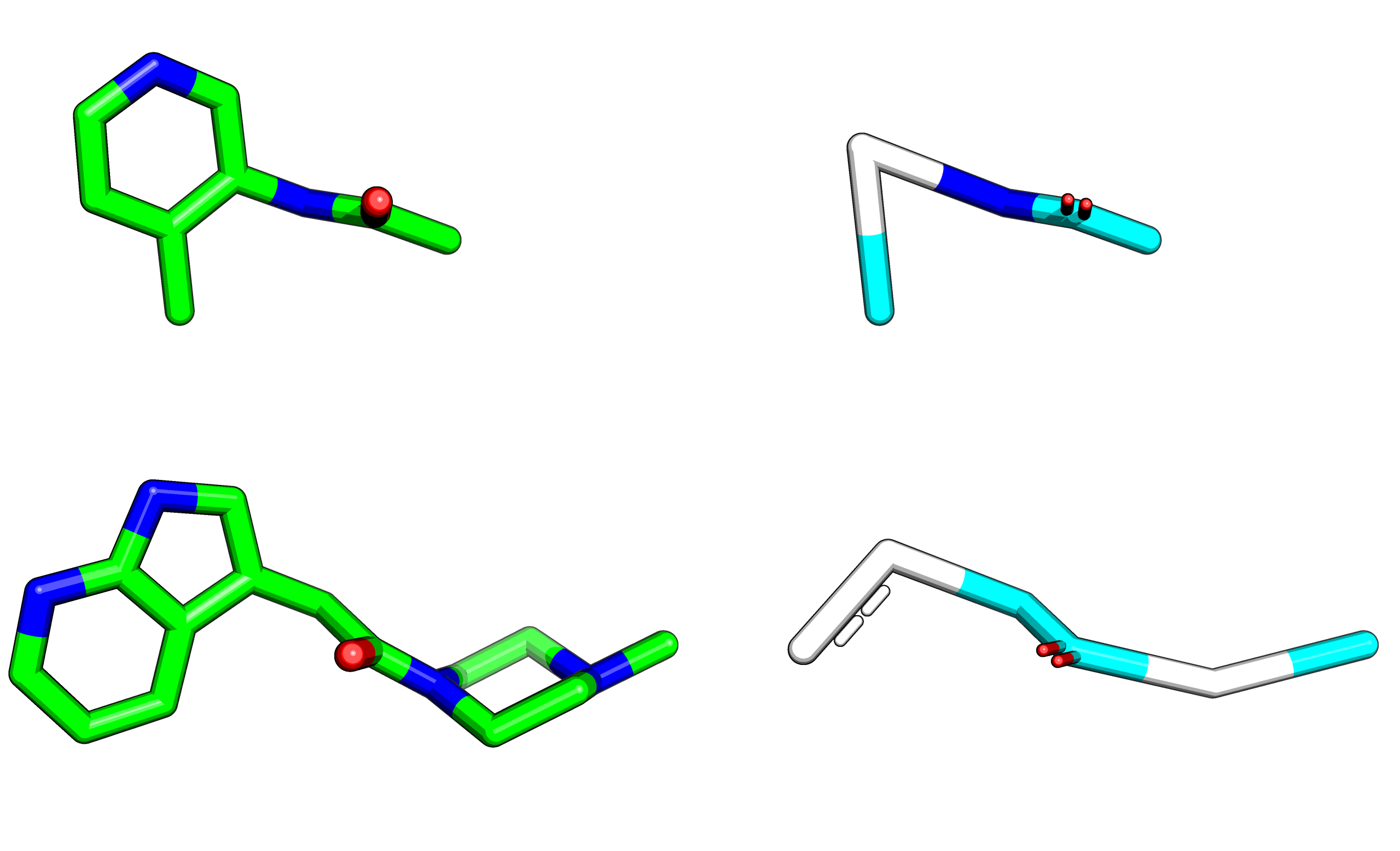
But it can be a bit unpredictable in the upacking step after merging, therefore it is not implemented in Victor with SMILES —although using full merge mode is inferior to permissive unmerged mode anyway. Instead,
.collapse_ring(mol).expand_ring(mol)
There are two ways. remembering the bonds or making new ones by proximity for the rings. The latter is a lot better for most cases as the rings are never 100% overlapping.
Nitty Gritty
If stuff goes wrong and after a few checks,
one wished to debug the collapsed molecule. This is stored in victor.fragmenstein.scaffold:
print(victor.fragmenstein._get_expansion_data(victor.fragmenstein.scaffold))
The data return is a list of length number of collapsed rings (naphthalene = 2, camphor = 2 not 3), here is the data for one “ringcore” atom:
{'_ori_name': 'toluene',
 '_ori_i': -1,
 '_ori_is': '[0, 5, 4, 3, 2, 1]',
 '_neighbors': '[[1, 5], [4, 6, 0], [3, 5], [2, 4], [1, 3], [0, 2]]',
 '_xs': '[1.5, 0.75, -0.75, -1.5, -0.75, 0.75]',
 '_ys': '[0.0, 1.299, 1.299, 0.0, -1.299, -1.299]',
 '_zs': '[0.0, 0.0, 0.0, 0.0, 0.0, 0.0]',
 '_elements': '["C", "C", "C", "C", "C", "C"]',
 '_bonds': '[["AROMATIC", "AROMATIC"], ["AROMATIC", "SINGLE", "AROMATIC"], ["AROMATIC", "AROMATIC"], ["AROMATIC", "AROMATIC"], ["AROMATIC", "AROMATIC"], ["AROMATIC", "AROMATIC"]]'}
Where ori is the original index. All ringcore atoms have an origin of -1.
Logging
See logging_and_debugging.md for more.
The correct logging is via Victor’s journal. The logging log Fragmenstein.
Valence
The class Rectifier attempts to fix the various issues that may have arisen.
Generally cases when the merger results in a valence that is higher than the element supports.
If so, the atom is shifted leftwards (and upwards) on the periodic table or the bond order is lowered.
Warhead harmonisation
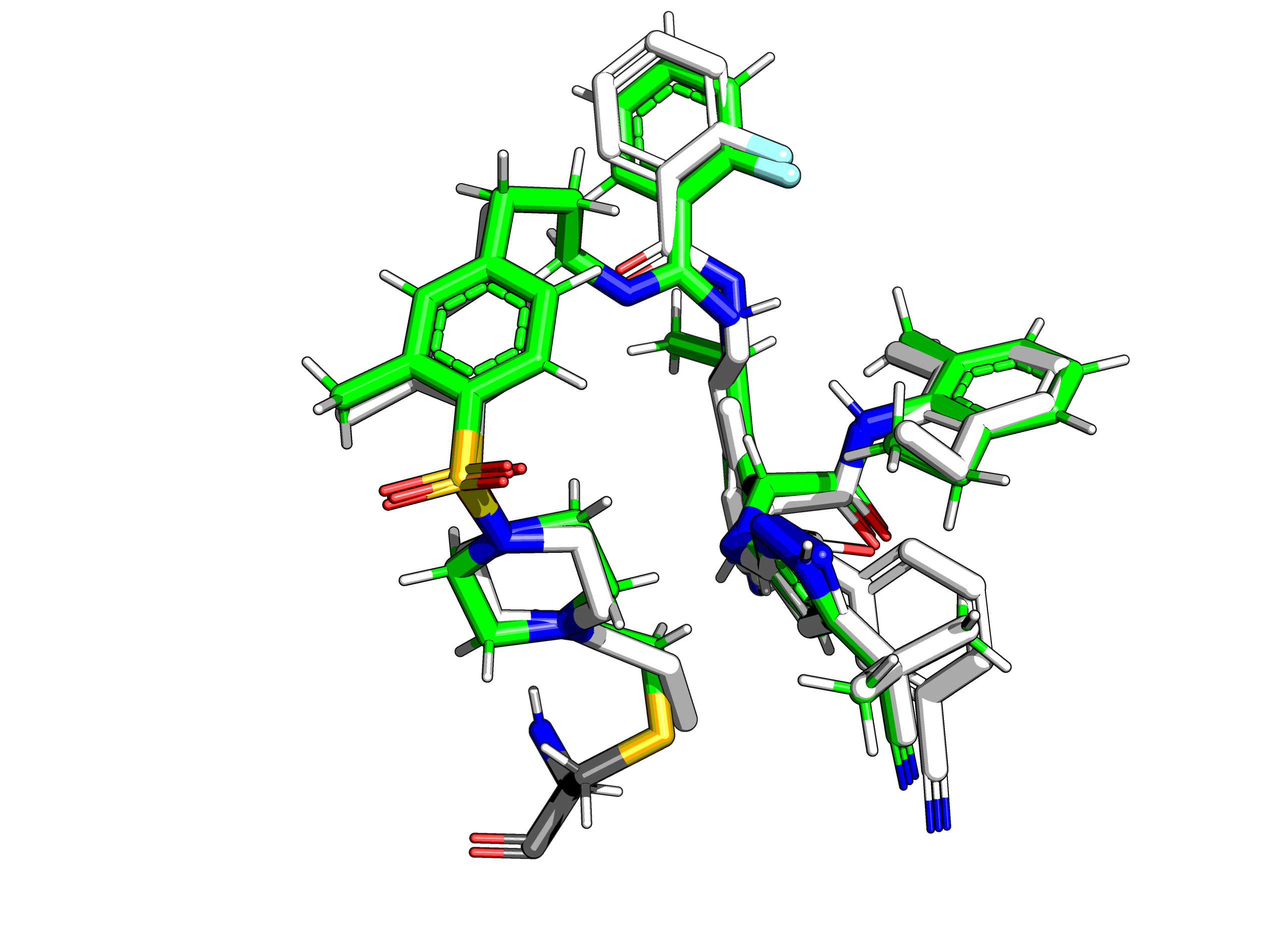
A issue arises merging different warheads. In which case they can be ignore, kept or the first warhead used. Bonding to a warhead is forbidden. Therefore, mergers may link up in unexpected ways, such as this, wherein two hits actually have different warheads.
Mad ones
If two rings intersect perpendicularly (e.g. x0708-x2193) the resulting bonding will be unexpected
(“emergency bonding” warning appears).
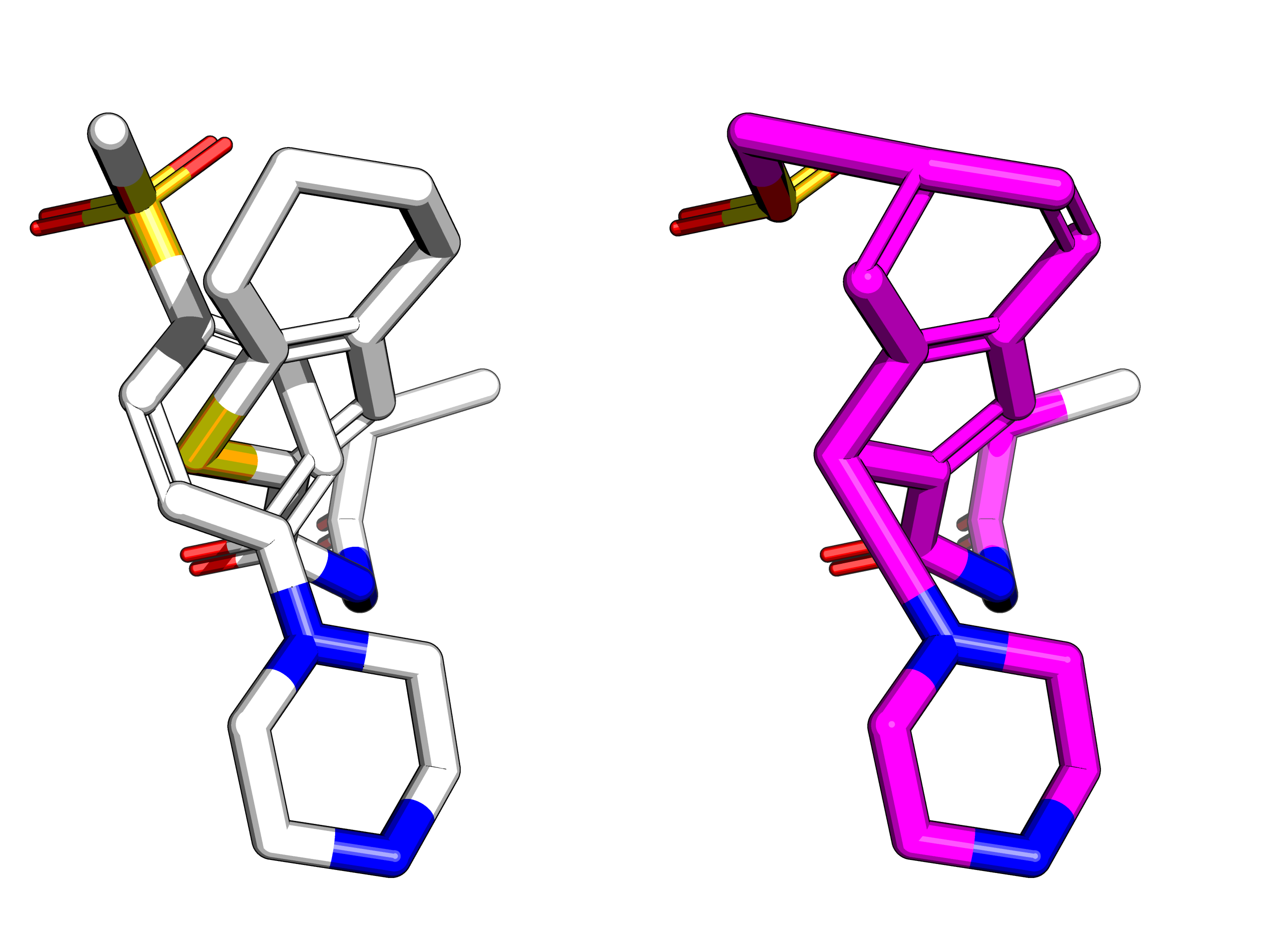
I have no idea how to resolve this or whether it should be.
NB. Spiro compounds are tolerated.
Fused rings
Even though azetine-benzene, cyclopropane-benzene and bridged compounds are chemically possible, these are corrected as they are unlikely to be intended. As a result bridges will be removed and for rings of size 3/4 will become 5.
Allenes
Additionally, allene are forbidden.
Code caveat
The code currently has many ring corrections in ‘collapse ring’ class (expansion part), while bond order corrections are in ‘rectifier’. Ideally these should be merged…