Three modes
This page is a bit out of date as the full mode now includes various corrections, for automatic merging, but the conclusion is the same.
nonemode of merging —i.e. mapping the followup molecule to each hit is the best even when there are incorrect inspiration hits.
As discussed, it has three main parts:
the pipeline (Victor class)
the minimiser (Egor class) and
the followup placing algorithm (Fragmenstein class)
The latter has three modes as discussed in the fragmenstein page: “full-merging”, “partial-merging” and “no-merging” for mapping.
Each has advantages and disadvantage. For the covid data, an analysis was done to figure out which.
50 followups were randomly chosen and placed with the three modes (165 total poses were done, +10% for safety).
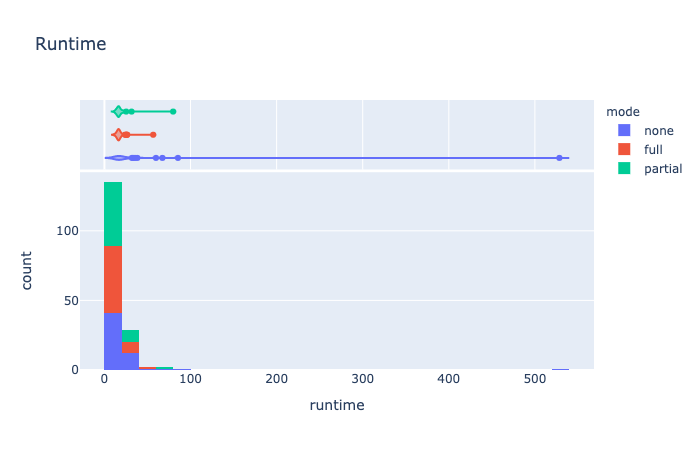
The medians of the various scores are:
mode |
∆∆G [kcal/mol] |
concatenated RMSD [Å] |
Number of constrained atoms |
Runtime [s] |
|---|---|---|---|---|
full |
-3.55336 |
0.940974 |
12 |
16.6215 |
none |
-4.02654 |
1.0435 |
14 |
17.5834 |
partial |
-3.23976 |
0.970151 |
13 |
16.7117 |
No merging mapping is better for both number of atoms used and the ∆∆G_bind. It scored worse for time and slightly for RMSD.
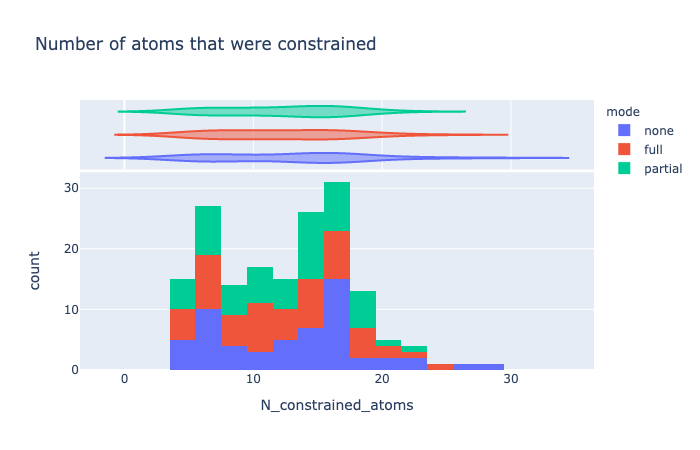
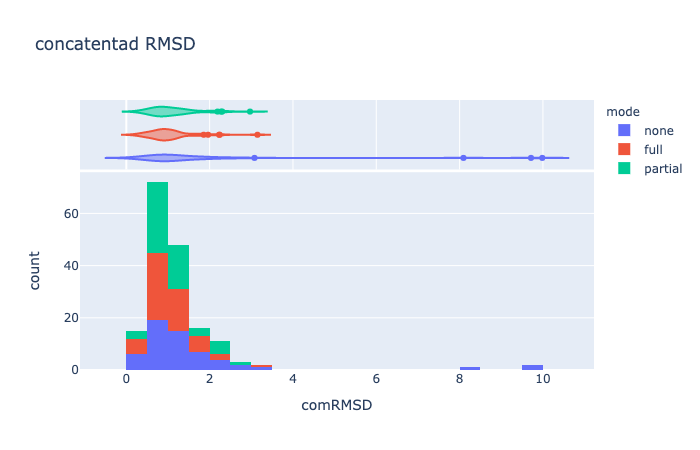
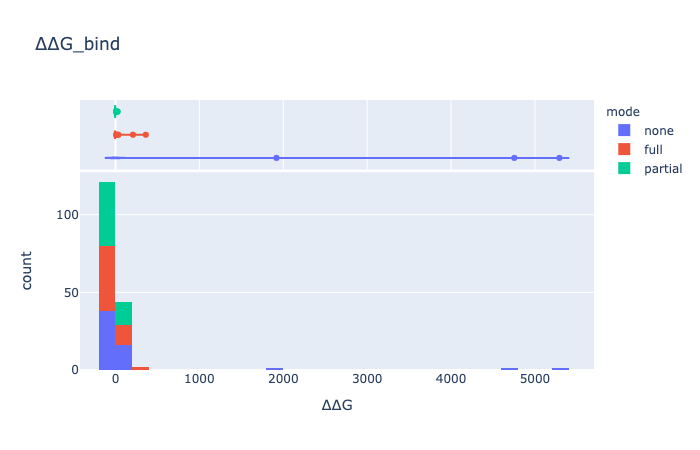
It is clear that the no merging mapping when it fails it fails badly. So let’s look solely at all ∆∆G < 0 ones:
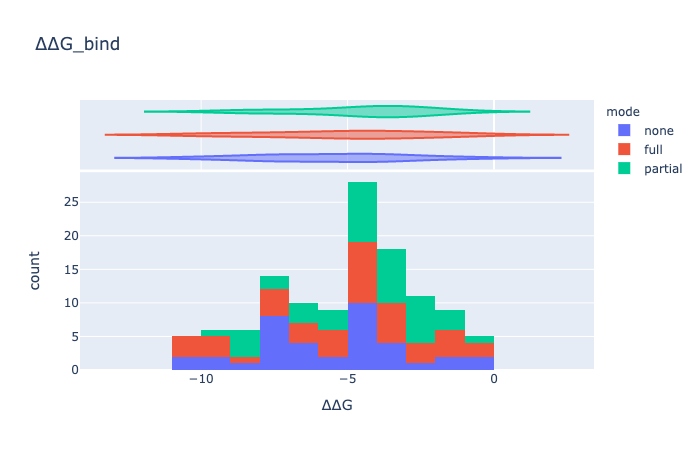
The outliers in ∆∆G are caused by erroneous hits being claimed to be inspirations. Here is one of these, WAR-XCH-b6889685-63 in the same colours as the graphs:
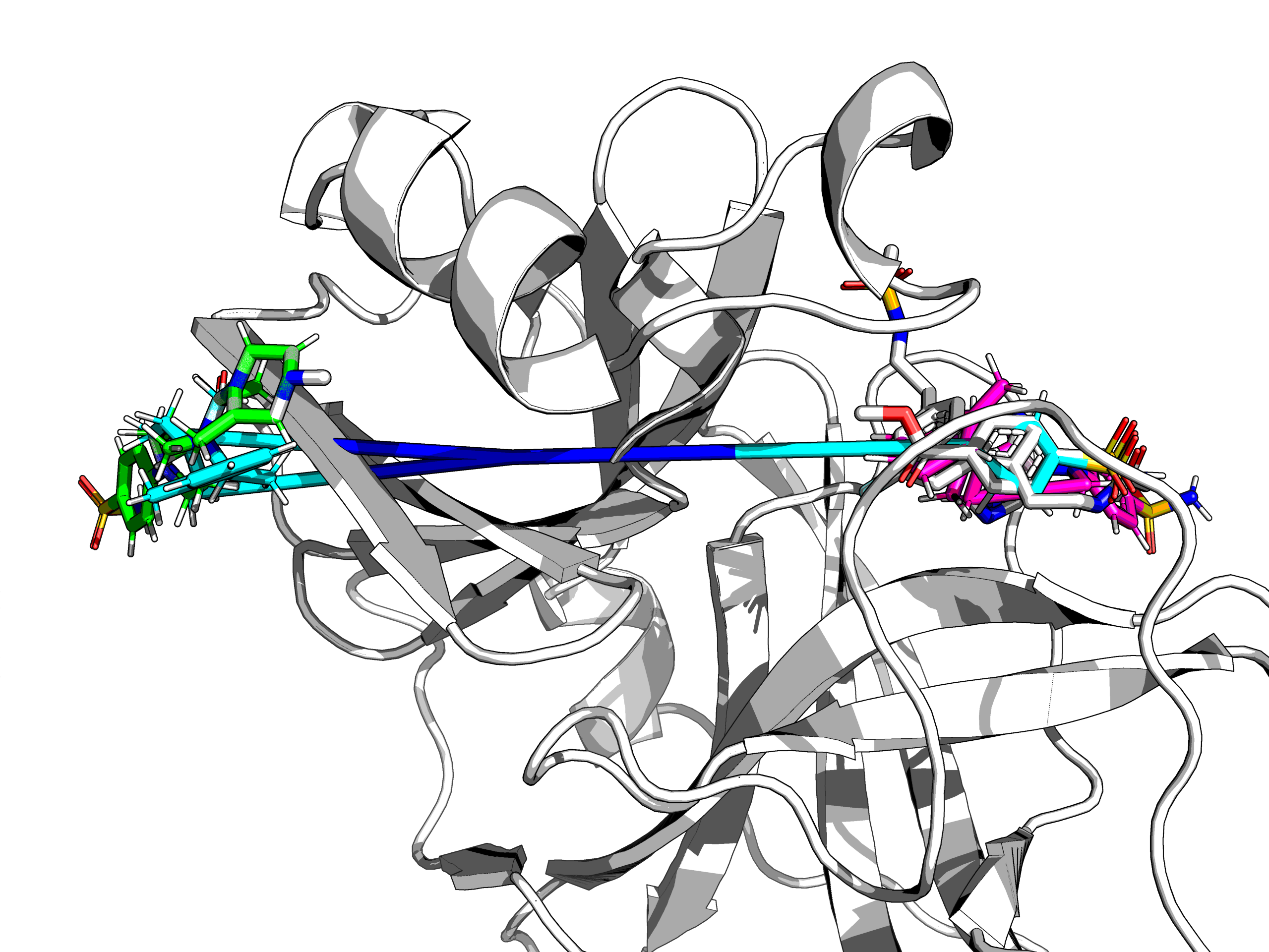
Namely the outlier is chosen as an inspiration and the bond length is not violated as the atoms from the mapped parts are not neighbours, so the 3 Å limit does not apply. Curiously, full-merger mapped to one cluster, while partial merger to the loner.
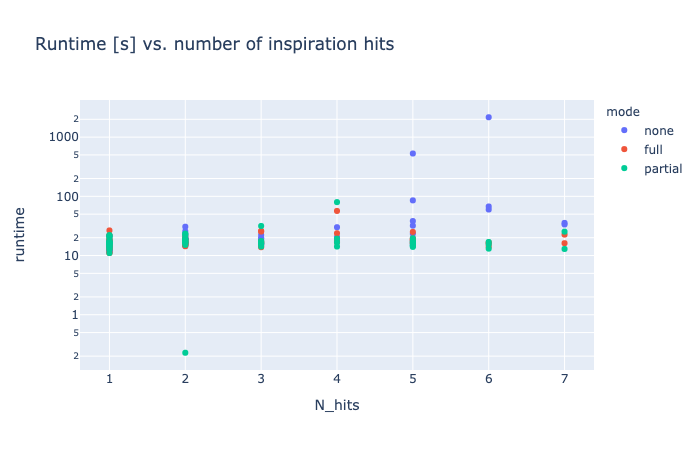
The time problem is substantial for the none.
.
These are the offenders:
name |
mode |
∆∆G |
comRMSD |
N_constrained_atoms |
runtime |
N_hits |
|
|---|---|---|---|---|---|---|---|
36 |
JAG-SYN-9c2cd0bd-13 |
none |
nan |
nan |
18 |
2164.83 |
6 |
156 |
WAR-XCH-b6889685-20 |
none |
-5.81899 |
1.43685 |
10 |
528.47 |
5 |
93 |
CHR-SOS-1f323c23-1 |
none |
-7.99253 |
0.65989 |
16 |
85.4308 |
5 |
98 |
RAM-SYN-2a37ce6c-4 |
partial |
-8.13456 |
2.2751 |
11 |
79.835 |
4 |
153 |
DRA-CSI-47e38074-1 |
none |
-4.02654 |
1.0435 |
13 |
67.3437 |
6 |
The JAG-SYN-9c2cd0bd-13 has nothing wrong with it. It dies after the igor step due to sanitisation (fixed).
The “none” mode excluded the following ['x0689', 'x0691', 'x0692', 'x0705', 'x0708'],
As a human at first glance I would have excluded ['x0689', 'x0692', 'x0705', 'x0708'], so keeping ['x0691', 'x0731'],
but looking better at it, 'x0691' would be in the list. So perfect!
However, 33 minutes is not an acceptable runtime.